Psychologists & Counsellors
Clinical Psychologist Counselling Psychologist Couple Counselling Online Counselling Rehabilitation Psychologist Relationship Counselling
Conditions We Treat
ADHD Adult ADHD Anger Management Autism Spectrum Behavioural Disorders Online Therapy Bipolar Disorder Breakup Support Conduct Disorder Child Counselling Family Counselling Occupational Therapy Counselling Online Counselling Eating Disorders Generalized Anxiety (GAD) Impulse Control Intellectual Disability Free Online Counselling Anxiety Self-Harm & Suicidal Online Counselling Depression OCD Panic Disorder PTSD & Trauma Sexual Addiction Sleep Problems Social Anxiety Oppositional Defiant (ODD) Personality Disorder Phobia Postpartum Depression Violence & Abuse Virtual Counselling
Therapy Approaches
CBT DBT
Life & Work Support
Bullying Career Counselling Procrastination Marriage Counselling Parenting Support Personal Stress Relationship Stress Self-Esteem & Confidence Stress Management Time Management Workplace Stress
Programs
Boost Self-Confidence Boost Motivation Control Overthinking Critical Thinking Skills Digital Detox Discover Your True Self Emotional Regulation Enhance Creativity Job Satisfaction Get Over a Breakup Heal From Grief Improve Relationships Family Therapy Overcome Anxiety Overcome Depression Overcome Exam Anxiety Overcome Guilt Overcome Parenting Stress Overcome Procrastination Resilience to Stress The Art of Listening → All 26 programs
Self-Assessments
Depression Test Anxiety Test Stress Test Adult ADHD Test Bipolar Test OCD Test Mental Well-being Sleep Pattern → All 57 assessments
Plans & Pricing
Session Plans & Packages Single Consultation Current Offers
Therapy Services
Occupational Therapy
Get Started
Get-Started For Dating Couple Get-Started For Individual Get-Started For Married Couple Get-Started For Teen → All conditions & services
Neurologists & clinical psychologists

Migraine Treatment & 8-Week Migraine Therapy — Symptoms, Causes and Care

Medicines treat the attack. This programme treats everything around it — triggers, sleep, meals, stress reactivity and the anticipatory anxiety that makes attacks worse. Eight weeks with a clinical psychologist, working alongside a neurologist for diagnosis and the right acute and preventive medicines — by video, from home.

  • Trigger diary that finds real patterns
  • Sleep and meals regularised
  • Daily relaxation that lowers reactivity
  • A written plan for during an attack

📅 8 weeks · 🩺 5 one-to-one sessions · 👩‍⚕️ Clinical psychologist · 🔒 Private · Check your migraine disability score

8 weeksStructured programme
5One-to-one sessions
50 minPer session
₹1,499Neurologist consult
2Languages: English, Hindi
7 DaysAvailable weekly
550+Verified experts

🎯 Find your match

Frequent attacks, painkiller overuse or triggers? Click your concern.

Matched to the clinician for exactly what you're dealing with — and your booking is pre-filled.

Not sure where to start? A care coordinator will tell you honestly — sometimes a single session is the better first step.

💬 WhatsApp coordinator

👩‍⚕️ Your care team

Meet your migraine care team

Verified · Qualified · Practising. NMC-registered doctors and RCI-licensed psychologists on one shared record.

View all experts

🏷️ Transparent pricing

Migraine treatment cost — the programme, or one consultation.

Join the full 8-week programme, or start with a single consultation.

Your sessions don't expire — miss a week and the plan waits for you. If the programme isn't working after the first session, we'll move you or refund the unused part. Medicines and tests are paid separately.

Quick overview

⚡ Migraine care at HopeQure, in 30 seconds.

  • Migraine is a neurological condition — recurring, often one-sided, throbbing headaches with nausea or sensitivity to light and sound
  • Best treated in two halves: medicines from a neurologist, and behavioural treatment for triggers, sleep, stress and attack fear
  • The 8-week programme: 5 one-to-one sessions with a clinical psychologist, a weekly plan, worksheets, messaging and Asha
  • Relaxation training, biofeedback and CBT are recommended for migraine prevention in major headache guidelines
  • Taking painkillers on 15+ days a month can cause medication-overuse headache — a neurologist can help you come down safely
  • Programme ₹28,000 · Neurologist or psychologist ₹1,499 off your first single consultation

Most asked question

Can a psychologist really help with migraine?

Yes. Migraine is neurological, but how often attacks happen and how much they disrupt life are shaped by sleep, meals, stress and fear. Relaxation training, biofeedback and cognitive behavioural therapy are evidence-based ways to reduce attack frequency and disability, and work best alongside medicines — not instead of them.

That's why the programme runs with your neurologist in the loop: your long-term plan is shared with your doctor at the end.

💰 8-week programme ₹28,000 · single sessions from ₹900
Emergency: a sudden "worst-ever" headache, headache with weakness, confusion, slurred speech, fever with a stiff neck, or after a head injury — call 108 now.

📘 Quick guide

What is migraine, and when should you see a neurologist?

What is migraine?

Migraine is a common neurological condition causing repeated attacks of moderate to severe headache, usually throbbing and often on one side, lasting 4 to 72 hours. Attacks commonly come with nausea, vomiting, and sensitivity to light and sound. About a third of people also get aura — visual zigzags, blind spots or tingling — before the headache.

Migraine is not "just a headache". It is one of the leading causes of disability worldwide, especially for women in their working years.

When should you see a neurologist?

  • Headaches on 4 or more days a month, or attacks that stop you working or studying
  • Taking painkillers on more than about 10–15 days a month
  • Current treatment isn't working, or causes side effects
  • Aura, or migraine and you take — or plan to take — the contraceptive pill
  • Your headache pattern has changed, or headaches started after 50
  • You're not sure it's migraine at all

Key facts about migraine

  • Migraine affects about 1 in 5 women, 1 in 16 men and 1 in 11 children.
  • Migraine is the second-leading cause of disability worldwide, and the first among young women (Steiner et al., Journal of Headache and Pain 2020, Global Burden of Disease data).
  • A population study in Karnataka found migraine in about 1 in 4 adults over a year; 38% of them had attacks on 3 or more days a month (Kulkarni et al., Journal of Headache and Pain 2015).
  • Using painkillers on 15 or more days a month (or triptans and combination tablets on 10 or more) for over 3 months can cause medication-overuse headache (ICHD-3).
  • Relaxation training, biofeedback and CBT are recommended treatments for preventing migraine (American Academy of Neurology evidence guidelines).
  • For women with migraine with aura, combined hormonal contraceptives raise ischaemic stroke risk — European headache and cardiology societies advise a doctor's review (2017 consensus).
  • Adding yoga to medicines reduced headache frequency and disability in an AIIMS New Delhi randomised trial (Neurology 2020).

Last reviewed October 2026 · Sources listed under Medical references.

🧭 Stages

The 4 stages of a migraine attack — and the symptoms of each.

A migraine is more than the headache. Many attacks move through four phases — though not everyone has all four, every time. Spotting the early phase lets you treat sooner, when medicines work best.

The four phases of a migraine attackProdrome up to 2 days before, aura 5 to 60 minutes, headache 4 to 72 hours, postdrome up to 2 days after. 1 · Prodromehours to 2 days before 2 · Aura5–60 min · ~1 in 3 people 3 · Headache4–72 hours if untreated 4 · Postdromeup to 2 days after pain peaks
🌅

1. Prodrome (warning)

  • Yawning, tiredness
  • Food cravings, thirst
  • Neck stiffness
  • Mood changes, irritability
  • Needing to pass urine more
✨

2. Aura

  • Zigzag lines, flashing lights
  • Blind spots
  • Pins and needles in hand or face
  • Difficulty finding words
  • Usually lasts 5–60 minutes
⚡

3. Headache (attack)

  • Throbbing pain, often one side
  • Nausea or vomiting
  • Sensitivity to light, sound, smell
  • Worse with movement
  • Lasts 4–72 hours if untreated
🌫️

4. Postdrome ("hangover")

  • Exhaustion, feeling drained
  • Poor concentration
  • Dizziness
  • Head tender to sudden movement
  • Up to 2 days

🧬 Types

Types of migraine and headache — which one is yours?

Getting the type right changes the treatment. These follow the International Classification of Headache Disorders (ICHD-3).

Episodic migraine

Fewer than 15 headache days a month — the most common pattern.

ICD-10: G43.0

Chronic migraine

15+ headache days a month for 3+ months, at least 8 with migraine features.

ICD-10: G43.7

Migraine with aura

Visual or sensory symptoms before or with the headache.

ICD-10: G43.1

Menstrual migraine

Attacks clustered around the start of periods.

ICD-10: G43.8

Vestibular migraine

Episodes of vertigo or dizziness linked to migraine.

ICD-10: G43.8

Medication-overuse headache

Daily headaches driven by frequent painkiller use.

ICD-10: G44.4

Tension-type headache

Band-like, pressing pain without nausea — often mixed with migraine.

ICD-10: G44.2

Cluster headache

Severe one-sided pain around the eye in bouts — needs a neurologist.

ICD-10: G44.0

Retinal (ocular) migraine

Temporary vision loss in one eye — needs an eye and neurology check.

ICD-10: G43.8

Silent migraine

Aura and other symptoms without the headache — more common with age.

ICD-10: G43.1

Hemiplegic migraine

Temporary one-sided weakness during aura — rare, needs a neurologist.

ICD-10: G43.1

Abdominal migraine

Recurrent tummy pain with nausea in children.

ICD-10: G43.D

🧬 Causes & risk factors

What causes migraine? Genes, the brain and triggers.

Migraine is a genetic neurological condition. A sensitive brain reacts to internal and external changes by activating the trigeminal nerve system and releasing pain-signalling chemicals such as CGRP — which is why newer medicines target CGRP.

👪

Who gets migraine

  • Runs in families — most people have a parent or sibling with it
  • About 3 times more common in women
  • Usually starts in the teens or twenties; peaks 30–40
  • Children get it too — about 1 in 11
📈

What raises the risk of worse migraine

  • Frequent painkiller use
  • Poor sleep and obesity
  • Anxiety and depression
  • High caffeine intake
  • Stressful life events
⚠️

Complications

  • Chronic migraine — 15+ headache days a month
  • Medication-overuse headache
  • Status migrainosus — an attack lasting over 72 hours
  • Persistent aura — aura lasting over a week (rare)
  • Migrainous infarction — stroke during aura (very rare)

🩺 Headache decoder

Migraine symptoms vs other headaches — what yours might mean.

Headache patterns, likely type and what a clinician does
What it feels likeLikely typeWhat a neurologist does
Throbbing, one-sided headache with nausea and light sensitivity, lasting hoursMigraine without auraConfirm diagnosis, acute plan (painkiller or triptan early in the attack), prevention if frequent
Zigzag lights, blind spots or tingling before the headacheMigraine with auraConfirm it's typical aura, review contraception and stroke risk factors, acute and preventive plan
Band-like pressure on both sides, no nauseaTension-type headachePosture, stress and sleep work; avoid overusing painkillers
Headache most days, painkillers on most daysMedication-overuse headache on top of migraineSupervised reduction of painkillers while starting a preventive
Attacks around periodsMenstrual migraineTiming-based plan around the cycle; hormone-aware prescribing
Dizziness or vertigo episodes with migraine historyVestibular migraineNeurologist review; balance and migraine prevention
🚨 Sudden 'worst-ever' headache, or headache with weakness, confusion, fever and stiff neck, or after injuryPossible brain bleed, stroke or infectionEmergency — call 108 now

Educational only — not a diagnosis. Talk to a neurologist

Headache red flags — when it's not migraine

⚡ Sudden or severe

  • A thunderclap headache reaching full strength within a minute
  • The worst headache of your life
  • Headache after a head injury

🧠 With nerve symptoms

  • Weakness, numbness or a drooping face
  • Confusion, slurred speech or fainting
  • Aura lasting over an hour, or a first-ever aura after 50

🌡️ With other illness

  • Fever and a stiff neck, or a rash
  • New headache in pregnancy or soon after delivery
  • New headache after 50, or with cancer or a weak immune system

🔎 Diagnosis

How migraine is diagnosed — and when you actually need an MRI.

🗣️

What your doctor asks

  • How often, how long, and where it hurts
  • Nausea, light or sound sensitivity, aura
  • Painkiller and medicine use per month
  • Sleep, periods, stress, family history
  • Anything new or different about the pattern
🧠

Do you need a scan?

Most people with typical migraine and a normal examination do not need an MRI or CT. Scans are used when there are red flags: a sudden or "worst-ever" headache, a changed pattern, nerve symptoms, headache starting after 50, or symptoms that don't fit migraine.

📔

What to bring — your diary

  • Date, start time and how long it lasted
  • Pain score 0–10 and where it hurt
  • Medicines taken, dose and whether they worked
  • Sleep, meals, period day, stress that day
  • Any aura or other symptoms

🧮 Free tools

How much is migraine costing you? Two quick checks.

The MIDAS score measures how many days migraine takes from work, home and social life over 3 months. The overuse check flags whether painkillers might be keeping headaches going. Both are screening guides, not diagnoses.

Migraine disability score (MIDAS)

Think about the last 3 months. Enter 0 if none.

MIDAS: Stewart et al., Neurology 2001. Grade I 0–5 · II 6–10 · III 11–20 · IV 21+.

Medication-overuse check

In a typical month over the last 3 months:

Thresholds from ICHD-3 (2018). Never stop prescribed medicines suddenly without advice.

MIDAS grade III or IV, or painkillers most days? See a neurologist.

A neurologist confirms the diagnosis, checks for medication overuse and decides whether you need prevention.

💊 Medicines

Migraine medicines explained — acute relief and prevention.

A reference for the medicines doctors in India commonly use. Every medicine here needs a prescription and a doctor's judgement about your other conditions, pregnancy plans and other medicines.

Migraine medicines by class
Medicine classExamplesUsed forKey cautions
Simple painkillers & NSAIDsParacetamol, ibuprofen, naproxen, aspirinMild–moderate attacks, taken earlyLimit to under 15 days a month; NSAIDs can upset the stomach and kidneys
TriptansSumatriptan, rizatriptan, zolmitriptan, naratriptanModerate–severe attacksLimit to under 10 days a month; not for people with heart disease, stroke or uncontrolled BP
Anti-sickness medicinesDomperidone, metoclopramide, prochlorperazineNausea and vomiting; help other medicines absorbShort-term use only; doctor advises the dose
Newer acute optionsGepants (e.g. rimegepant), ditans (lasmiditan)When triptans fail or aren't suitableAvailability and cost vary in India
Beta-blockersPropranolol, metoprololPreventionAvoid in asthma; can cause tiredness and cold hands
AntidepressantsAmitriptyline, nortriptylinePrevention — especially with poor sleep or tension-type headacheDrowsiness, dry mouth, weight gain
Calcium-channel blockerFlunarizine (widely used in India)PreventionDrowsiness, weight gain, low mood — avoid with depression
Anti-seizure medicinesTopiramate, sodium valproatePreventionValproate must be avoided in women who could become pregnant; topiramate needs contraception advice
CGRP-targeting medicinesErenumab, fremanezumab, galcanezumab; atogepantPrevention when others failMonthly or quarterly injections, or a daily tablet; not in pregnancy
Botox (onabotulinumtoxinA)Injections every 12 weeksChronic migraine onlyGiven by a trained specialist

Never start, stop or combine migraine medicines on your own. Preventives usually take 6–8 weeks to show their effect.

💊 Treatment

How migraine is treated — four layers that work together.

⚡

Acute treatment

Taken early in an attack: painkillers or anti-inflammatories, triptans, and anti-sickness medicines — chosen and limited by your neurologist to avoid overuse.

🛡️

Preventive treatment

For frequent or disabling attacks: daily preventives, and newer options such as CGRP-targeting medicines or Botox for chronic migraine where suitable.

🧠

Behavioural treatment

Relaxation training, biofeedback and CBT — the core of the 8-week programme, and recommended alongside medicines.

🌙

Lifestyle levers

Regular sleep, regular meals, hydration, steady caffeine, gentle exercise and a diary — small, steady, and evidence-based.

Medicines are prescribed only by a doctor after assessment. Never start, stop or combine migraine medicines without advice.

During an attack

What to do during a migraine attack — 7 steps

  1. Treat early. Take your prescribed acute medicine at the first sign of pain — not when it's already severe.
  2. Lie down in a dark, quiet room and close your eyes.
  3. Apply a cold pack to the forehead or back of the neck (some prefer warmth).
  4. Sip water, especially if you've been vomiting.
  5. A small amount of caffeine can help some people — but not if you already have a lot daily.
  6. Try slow breathing or the relaxation you practise between attacks.
  7. Rest, then return gradually — the postdrome can leave you drained for a day or two.

If an attack lasts more than 72 hours, or feels different from your usual attacks, get medical help.

Yoga, supplements & complementary care

What helps alongside medicines

  • Yoga: an AIIMS New Delhi randomised trial found yoga added to medicines reduced headache frequency and disability more than medicines alone (Neurology 2020).
  • Magnesium, riboflavin (vitamin B2) and coenzyme Q10: modest evidence for prevention; generally well tolerated — ask your doctor about doses.
  • Feverfew: some evidence; avoid in pregnancy.
  • Butterbur: evidence exists, but some products can damage the liver — avoid unless your doctor advises a certified product.
  • Acupuncture: may help some people as an add-on.
  • Ayurvedic or herbal products: tell your doctor what you take — some interact with medicines.

🎯 What changes

What changes by the end of 8 weeks — not promises, what people report.

📔

A trigger diary that finds patterns

Real patterns, not myths — including early warning signs that look like triggers.

😴

Sleep and meals regularised

The two most reliable levers for a brain that dislikes change.

🧘

Relaxation, practised daily

Applied relaxation that lowers stress reactivity, done properly.

🛡️

Less fear of the next attack

A plan for during an attack, and fewer things avoided in between.

Who it's for: people with diagnosed migraine who want the non-drug half of the treatment. Not diagnosed yet? .

🗓️ The plan

The 8-week migraine therapy plan, week by week — all of it, before you pay.

  1. Week 1

    The diary

    Attacks, sleep, meals, stress — for a week.

    This week: Fill it daily.

  2. Week 2

    The first session

    Your psychologist reads the diary for patterns.

    This week: One regularity.

  3. Week 3

    Sleep and meals

    The two most reliable levers.

    This week: Hold both.

  4. Week 4

    Relaxation

    Applied relaxation, done properly.

    This week: Daily practice.

  5. Week 5

    Stress reactivity

    Reacting less to the things you cannot remove.

    This week: One change.

  6. Week 6

    The attack itself

    Session four: a plan for during.

    This week: Use it once.

  7. Week 7

    Between attacks

    Reducing anticipatory fear.

    This week: Do one avoided thing.

  8. Week 8

    Keeping it

    Session five: the long plan, shared with your doctor.

    This week: Write it.

🔍 Triggers

Common migraine triggers — and why a diary beats a list.

Some "triggers" are really early signs of an attack already starting — craving chocolate, yawning, light sensitivity. A diary separates the two, so you don't give up things you don't need to.

Too little or too much sleep
Skipped or late meals
Stress — and the let-down after it
Hormonal changes around periods
Dehydration and heat
Caffeine — too much, or sudden withdrawal
Bright or flickering light, screens
Alcohol, especially red wine

🌸 Women & migraine

Migraine in women — periods, the pill and pregnancy.

Migraine is about three times more common in women, and hormones shape it at every stage.

📅

Period-related migraine

Attacks around the start of periods are often longer. A timing-based plan around your cycle can help.

💊

The pill and aura

If you have migraine with aura, combined hormonal contraceptives raise stroke risk. Ask a doctor before starting or continuing them.

🤰

Pregnancy & breastfeeding

Many women get fewer attacks in pregnancy, but medicine choices change. Plan with your doctor; behavioural treatment is safe throughout.

🧒 Children & teens

Migraine in children and teenagers — often missed.

⏱️

Shorter, different attacks

Children's attacks can last as little as 2 hours, often affect both sides of the head, and may look like tiredness, paleness or crankiness.

🤢

Abdominal migraine

Repeated tummy pain with nausea and no headache — often in children who later develop typical migraine.

📚

Exams, screens and sleep

Irregular sleep, skipped breakfast, dehydration and exam stress are common triggers. See a paediatrician, and use our child psychologists for stress.

❓ Myths vs facts

Migraine myths vs facts — what the evidence says.

Myth

Migraine is just a bad headache.

Fact: Migraine is a neurological condition with a whole-body attack — nausea, sensory sensitivity, aura and a postdrome — and is the second leading cause of disability worldwide.

Myth

My 'sinus headache' can't be migraine.

Fact: Many people with recurring 'sinus headaches' — with a blocked nose or watery eyes — actually have migraine. True sinus infection usually comes with fever and thick discharge.

Myth

Painkillers every day are harmless.

Fact: Taking them on 15+ days a month can cause medication-overuse headache and make headaches more frequent.

Myth

Only women get migraine.

Fact: It is three times more common in women, but men and children get it too.

Myth

Every migraine needs a scan.

Fact: Typical migraine with a normal examination rarely needs an MRI or CT. Scans are for red flags.

Myth

Nothing can be done.

Fact: There's no cure, but the right acute plan, prevention and behavioural treatment cut attacks and disability for most people.

🤝 One programme, one team

Neurologist, psychologist and specialists — one migraine plan.

Migraine sits between neurology and behaviour. Your clinicians work on one shared record, and your long-term plan is shared with your doctor.

Neurologist

Lead doctor

Diagnosis, red-flag checks, acute and preventive medicines, medication-overuse plans.

Clinical psychologist

Programme lead

Diary, relaxation, stress reactivity, attack plan and anticipatory fear.

General physician

Coordination

BP, blood tests and day-to-day health on one record.

Clinical dietitian

When needed

Meal timing, hydration, caffeine and food-trigger review.

Gynaecologist

When needed

Menstrual migraine, contraception with aura, pregnancy planning.

Ophthalmologist

When needed

Visual symptoms that need an eye check to rule out other causes.

Physiotherapist

When needed

Neck pain and posture that feed into headaches.

Yoga expert

Optional

Breathing and gentle yoga to support relaxation practice.

Asha companion

Between sessions

Free on the programme for the days in between — backed by your clinicians.

Core teamJoins when your health needs it

💻 Simple process

How the migraine programme works — 5 steps.

  1. 1

    Talk to a coordinator

    They confirm the fit — and tell you if a single session is the better start.

  2. 2

    Get matched

    A clinician matched to what you're working on and when you're free. Switch after session one if you want.

  3. 3

    Start the diary

    A week of attacks, sleep, meals and stress before your first session.

  4. 4

    Five sessions

    50 minutes each by video or audio, with one practice a week between them.

  5. 5

    Your long plan

    Written in week 8 and shared with your doctor, so the gains last.

📋 Treatment protocols

Evidence-based migraine care — four structured pathways.

PROTO-MIG-01

Acute Attack Plan

Neurologist-led

  1. Diagnose: Confirm migraine type and screen for red flags
  2. Step plan: Treatment taken early in the attack, matched to attack severity
  3. Limit: A monthly cap on acute medicines to prevent overuse
  4. Review: Adjust after 2–3 attacks if relief is poor

Goal: Fast, reliable relief without overuse

PROTO-MIG-02

Prevention Pathway

8–12 week trial per medicine

  1. When: 4+ migraine days a month, or disabling attacks
  2. Choose: Preventive matched to your other conditions and plans such as pregnancy
  3. Track: Diary-based review of migraine days and MIDAS
  4. Escalate: Newer preventives or Botox for chronic migraine when suitable

Goal: Fewer migraine days and lower disability

PROTO-MIG-03

Medication-Overuse Reset

4–12 weeks · supervised

  1. Identify: Count painkiller and triptan days against ICHD-3 limits
  2. Start: Preventive treatment first or alongside
  3. Reduce: Planned reduction of overused medicines with a bridging plan
  4. Support: Psychologist support through the difficult weeks

Goal: Back to episodic headaches

PROTO-MIG-04

8-Week Behavioural Programme

Clinical psychologist-led

  1. Diary: Patterns, not myths
  2. Regularity: Sleep and meals steadied
  3. Relaxation: Applied relaxation and stress reactivity
  4. Fear: Attack plan and less avoidance; long plan shared with your doctor

Goal: Fewer attacks, and less fear between them

Ready for the non-drug half of treatment? Join the 8-week programme.

Five sessions, one practice a week, and support between sessions — your long plan shared with your doctor.

Join the programme · ₹28,000

🏆 How we compare

Choosing migraine treatment — what a complete plan includes.

Comparison of migraine care options
FeatureHeadache appSingle clinic visitHopeQure programme
Neurologist for diagnosis and medicinesRarely✓✓
Clinical psychologist for triggers, stress and fearRarelyRarely✓ 5 sessions
Structured week-by-week planSometimesNo✓
Medication-overuse checkNoSometimes✓
Red-flag screeningNo✓✓
Support between sessionsApp onlyNo✓ Messaging + Asha
Women's hormone-aware adviceRarelySometimes✓
Plan shared with your doctorNo—✓

General comparison of care types, not of any named provider.

📱 HopeQure App

Your migraine plan in your pocket — anywhere, anytime.

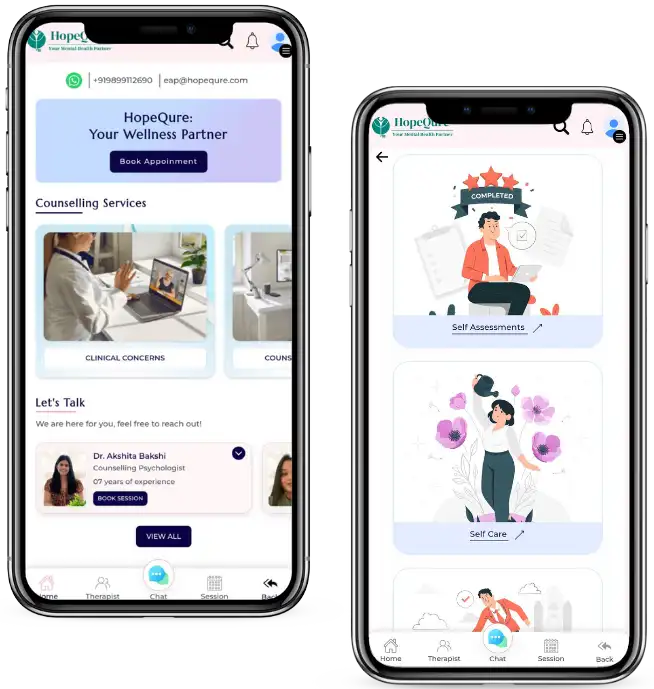
Download the HopeQure app to book confidentially, message your care team and keep your diary, worksheets, plan and prescriptions in one place.

  • Book and attend consultations from anywhere
  • End-to-end encrypted in-app messaging
  • Prescriptions and uploaded reports in one place
  • Reminders for follow-ups, medicines and tests
HopeQure mobile app for migraine care

💬 FAQs

Migraine FAQs — questions people ask.

What exactly do I get for the fee?
5 one-to-one sessions with a clinical psychologist, an 8-week plan with one practice a week, worksheets and summaries after every session, messaging between sessions, and Asha free while you are on the programme. One payment, nothing recurring.
Can a psychologist help with migraine?
Yes. Relaxation training, biofeedback and cognitive behavioural therapy are recommended for migraine prevention. They reduce how often attacks happen and how much they disrupt life, and work best alongside medicines from a neurologist.
What is the best treatment for migraine?
Usually a combination: acute medicines taken early in an attack, preventive treatment if attacks are frequent or disabling, and behavioural treatment for sleep, meals, stress and triggers. A neurologist tailors the medicines; the programme covers the behavioural half.
What are the 4 stages of a migraine?
Prodrome (warning signs such as yawning, cravings or neck stiffness, up to 2 days before), aura (visual or sensory symptoms for 5–60 minutes, in about a third of people), the headache itself (4–72 hours if untreated) and postdrome (a drained, foggy feeling for up to 2 days). Not every attack has all four.
What causes migraines?
Migraine is a genetic neurological condition. A sensitive brain reacts to internal or external changes — sleep, meals, hormones, stress — by activating the trigeminal nerve system and releasing pain-signalling chemicals such as CGRP.
How long does a migraine last?
Usually 4 to 72 hours if untreated, in adults. Children's attacks can be shorter. An attack lasting more than 72 hours is called status migrainosus and needs medical help.
What helps a migraine go away fast?
Taking your prescribed acute medicine at the very start of the pain, then resting in a dark, quiet room with a cold pack, sipping water and slow breathing. Treating early works far better than waiting until the pain is severe.
Do I need an MRI or CT scan for migraine?
Usually not. Typical migraine with a normal examination rarely needs a scan. Doctors order one when there are red flags, such as a sudden severe headache, a changed pattern, nerve symptoms or a new headache after 50.
What is the best medicine for migraine in India?
There is no single best medicine. For attacks, doctors commonly use paracetamol or NSAIDs, or triptans such as sumatriptan or rizatriptan. For prevention, common choices include propranolol, amitriptyline, flunarizine and topiramate, with CGRP-targeting medicines or Botox when others fail. A neurologist chooses based on your health.
How much does migraine treatment cost at HopeQure?
The 8-week Migraine Programme costs ₹28,000 as one payment. A neurologist, clinical psychologist or dietitian consultation is ₹1,499 and a general physician ₹900. Medicines and tests are extra.
Is this therapy, or a course?
Both, deliberately. The sessions are real clinical sessions with a licensed professional; the weeks between them give you something specific to work on, which is what makes the sessions go further.
How do I know if I have migraine or just a headache?
Migraine attacks are usually moderate to severe, throbbing, often one-sided, worse with activity, and come with nausea or sensitivity to light and sound, lasting 4 to 72 hours. Tension-type headaches feel like a band of pressure without nausea. A neurologist can confirm which you have.
Can taking painkillers too often make migraine worse?
Yes. Using simple painkillers on 15 or more days a month, or triptans and combination tablets on 10 or more, for over 3 months can cause medication-overuse headache. A neurologist can plan a safe reduction while starting a preventive.
When is a headache an emergency?
Call 108 for a sudden, severe 'worst-ever' headache, a headache with weakness, numbness, confusion or slurred speech, a headache with fever and a stiff neck, or a headache after a head injury.
Is migraine hereditary?
Yes. Migraine strongly runs in families, and most people with migraine have a parent, sibling or child who also has it.
What is a silent migraine?
A silent migraine is a migraine attack — usually with aura, nausea or light sensitivity — without the headache. It becomes more common with age and should be checked by a doctor the first time to rule out other causes.
Does yoga help migraine?
Yes, as an add-on. A randomised trial at AIIMS New Delhi found that adding regular yoga to medicines reduced headache frequency, intensity and disability more than medicines alone.
Which vitamins or supplements help migraine?
Magnesium, riboflavin (vitamin B2) and coenzyme Q10 have modest evidence for preventing migraine and are generally well tolerated. Ask your doctor about suitable doses, especially in pregnancy or with kidney disease.
Can a sinus headache actually be migraine?
Often, yes. Many people with recurring 'sinus headaches' have migraine with nasal symptoms. A true sinus infection usually comes with fever, thick nasal discharge and facial pain.
Can children get migraine?
Yes — about 1 in 11 children. Their attacks are often shorter, may affect both sides of the head, and can show up as tummy pain (abdominal migraine). A paediatrician can confirm the diagnosis.
Can I take the contraceptive pill if I have migraine?
If you have migraine with aura, combined hormonal contraceptives raise the risk of stroke and are usually avoided. Women with migraine without aura should also review this with a doctor, especially if they smoke or have other risk factors.
What are the most common migraine triggers?
Changes in sleep, skipped meals, stress and the let-down after it, hormonal changes around periods, dehydration, too much or too little caffeine, bright light and alcohol. A diary separates real triggers from early warning signs of an attack.
Can migraine be cured permanently?
There is no permanent cure, but most people can greatly reduce how often attacks happen and how much they affect life with the right combination of medicines, behavioural treatment and lifestyle changes.
What if I miss a week?
Nothing is lost. The plan waits for you and your sessions do not expire — you keep them until you have used them. Life happening is not a reason to fall out of care.
Can I choose my clinician?
A coordinator matches you based on what you are working on and when you are free, and you can ask for someone else after the first session without explaining why.
What if it is not right for me?
Tell the coordinator before you pay and they will say so — sometimes a single session or an assessment is the better start. If it is not working after the first session, we will move you or refund the unused part.
Is it confidential?
Yes. Nothing is shared with your employer, family or anyone else without your written permission, including on a company plan.
Is it available outside India?
Yes. Sessions are by video or audio, and programmes run in English and Hindi. The price shown is set for your country.

Still have questions?

Our care team is available 7 days a week. Get answers quickly.

🇮🇳 हिंदी में

माइग्रेन (आधासीसी) क्या है? इलाज और 8-सप्ताह का कार्यक्रम

माइग्रेन एक न्यूरोलॉजिकल (दिमाग़ से जुड़ी) स्थिति है, जिसमें बार-बार तेज़, धड़कता हुआ सिरदर्द होता है — अक्सर सिर के एक तरफ़। इसके साथ जी मिचलाना, उल्टी, और रोशनी व आवाज़ से परेशानी होती है। एक दौरा 4 से 72 घंटे तक चल सकता है।

इलाज दो हिस्सों में होता है: न्यूरोलॉजिस्ट दवाइयाँ तय करते हैं — दौरे के समय की दवा और बचाव की दवा। साथ ही HopeQure का 8-सप्ताह का कार्यक्रम क्लिनिकल साइकोलॉजिस्ट के साथ ट्रिगर डायरी, नींद, भोजन, तनाव और अगले दौरे के डर पर काम करता है — 5 व्यक्तिगत सत्र, हिंदी या अंग्रेज़ी में।

तुरंत 108 पर कॉल करें अगर अचानक बहुत तेज़ सिरदर्द हो, कमज़ोरी, बोलने में दिक़्क़त, बुख़ार के साथ गर्दन में अकड़न, या सिर में चोट के बाद सिरदर्द हो।

📍 Pan-India coverage

Migraine therapy in every Indian city.

The same clinicians and the same evidence-based programme — by video, wherever you are in India or abroad.

✔ Medical review

Medically reviewed content — our editorial standards.

🩺

Clinical review

Clinical statements on this page are reviewed against ICHD-3, American Headache Society and European Headache Federation guidance by the HopeQure Medical Advisory Board.

📝

Editorial standards

Reviewed at least every 6 months, and whenever a major guideline changes. No pharmaceutical sponsorship, no affiliate links; corrections are logged.

📅

Last reviewed

· Next scheduled review: April 2027 · Editorial contact: contactus@hopequre.com

📖 References

Medical references and clinical guidelines.

  1. Headache Classification Committee of the International Headache Society. The International Classification of Headache Disorders, 3rd edition (ICHD-3). Cephalalgia. 2018;38(1):1–211.
  2. Steiner TJ, et al. Migraine remains second among the world's causes of disability, and first among young women: findings from GBD2019. J Headache Pain. 2020;21:137.
  3. Kulkarni GB, et al. Headache disorders and public ill-health in India: prevalence estimates in Karnataka State. J Headache Pain. 2015;16:67.
  4. Stewart WF, et al. Development and testing of the Migraine Disability Assessment (MIDAS) Questionnaire to assess headache-related disability. Neurology. 2001;56(6 Suppl 1):S20–S28.
  5. Silberstein SD. Practice parameter: evidence-based guidelines for migraine headache (an evidence-based review). Neurology. 2000;55(6):754–762.
  6. Ailani J, et al. The American Headache Society Consensus Statement: update on integrating new migraine treatments into clinical practice. Headache. 2021;61(7):1021–1039.
  7. Diener HC, et al. Pathophysiology, prevention, and treatment of medication overuse headache. Lancet Neurol. 2019;18(9):891–902.
  8. Sacco S, et al. Hormonal contraceptives and risk of ischemic stroke in women with migraine: a consensus statement from the European Headache Federation and the European Society of Contraception and Reproductive Health. J Headache Pain. 2017;18:108.
  9. Penzien DB, Rains JC, Andrasik F. Behavioral management of recurrent headache: three decades of experience and empiricism. Appl Psychophysiol Biofeedback. 2002;27(2):163–181.
  10. Eigenbrodt AK, et al. Diagnosis and management of migraine in ten steps. Nat Rev Neurol. 2021;17(8):501–514.
  11. Board of Governors in supersession of the Medical Council of India. Telemedicine Practice Guidelines. New Delhi; 2020.
  12. Kumar A, Bhatia R, et al. Effect of yoga as add-on therapy in migraine (CONTAIN): a randomized clinical trial. Neurology. 2020;94(21):e2203–e2212.
  13. Holland S, et al. Evidence-based guideline update: NSAIDs and other complementary treatments for episodic migraine prevention in adults. Neurology. 2012;78(17):1346–1353.
  14. Ravishankar K, et al. Guidelines on the diagnosis and the current management of headache and related disorders. Ann Indian Acad Neurol. 2011;14(Suppl 1):S40–S59.
  15. World Health Organization. Migraine and other headache disorders — fact sheet. Geneva: WHO.

Ready when you are

Fewer attacks, and less fear between them — start your migraine plan.

A clinical psychologist for the behavioural half, a neurologist for the medical half, one shared plan. 8-week programme ₹28,000 · single consultations from ₹900

🔒 100% confidential✅ NMC & RCI-registered clinicians🗓️ Sessions never expire🌐 English & Hindi
💬 WhatsApp 📅 Book Now